
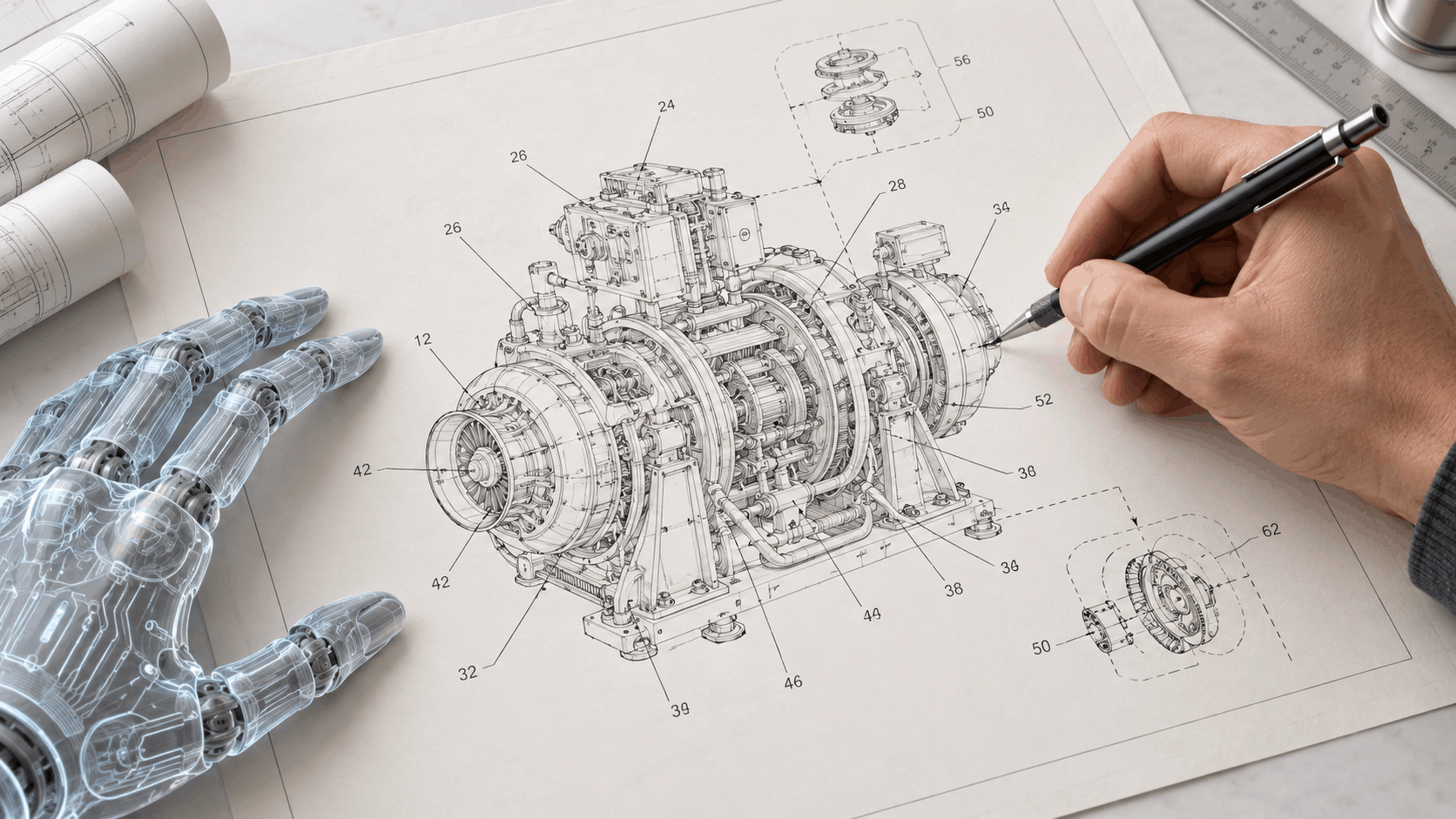
I have spent my career at the intersection of science and the law, and I cannot remember a question arriving in my office as fast as this one. A founder uses a generative AI tool to design a molecule, optimize a circuit, or draft a new mechanism, and then asks the natural next question: can we patent this, and if we can, who actually owns it? The answer has become much clearer over the past year, and some of what founders think they know is now out of date.
This article walks through where the United States Patent and Trademark Office and the courts currently stand on AI-assisted inventions, what changed at the end of 2025, and the practical steps I recommend before you file. As with everything I write here, this is education rather than legal advice; every situation depends on its specific facts.
The Rule That Has Not Changed: Only Humans Can Be Inventors
Start with the one principle that has survived every development so far. Under United States patent law, an inventor must be a natural person. The Federal Circuit confirmed this in Thaler v. Vidal, a case in which an AI system called DABUS was listed as the sole inventor on two patent applications. The court held that the Patent Act’s definition of an inventor refers to human beings, and the applications were rejected.
That means an AI system cannot be named as an inventor on a patent application, no matter how large its contribution was. If an invention were truly conceived entirely by a machine with no meaningful human contribution, it would currently have no valid inventor at all, and no one could patent it. For founders, the practical question is never whether the AI can be the inventor. It is whether the humans involved contributed enough to qualify.
What Changed in November 2025: AI Is a Tool, Not a Co-Inventor
In February 2024, the USPTO issued guidance that tried to measure whether a human made a significant enough contribution to an AI-assisted invention, borrowing a framework known as the Pannu factors that courts normally use to sort out joint inventorship between multiple people. In practice, that approach created real uncertainty. It invited examiners to treat the AI system almost like a co-inventor whose contribution had to be weighed against the human’s.
On November 28, 2025, the USPTO rescinded that guidance entirely and replaced it with a simpler framework. The revised guidance treats an AI system the way patent law has always treated laboratory equipment, simulation software, and other tools. A researcher who uses a powerful tool to develop an idea does not lose inventorship because the tool did heavy lifting; the human who conceived the complete and operative invention remains the inventor.
Two points from the revised guidance matter most for founders. First, there is no separate or modified inventorship standard for AI-assisted inventions; the same rules apply to every application. Second, when several people collaborate on an AI-assisted invention, the traditional joint inventorship analysis still applies between the humans, and each named inventor must have made a significant contribution to conception. The AI’s involvement does not change that analysis.
One caution belongs here. USPTO guidance binds patent examiners, but it does not bind the federal courts. A patent that issues under this framework can still be challenged in litigation, and courts will want credible evidence of human conception. That gap between examination and enforcement is precisely why documentation, which I cover below, matters so much.
Ownership Is a Separate Question from Inventorship
Founders often collapse two different legal questions into one. Inventorship asks who conceived the invention. Ownership asks who holds the rights to it. Under United States law, patent rights initially belong to the inventors personally, not to the company they work for, unless something transfers those rights. That something is almost always a written assignment.
This is where startups get hurt. An engineer who invented a core feature before signing an invention assignment agreement, a contractor who built a prototype under a handshake arrangement, or a technical co-founder who left before paperwork was signed can each create a gap in the company’s chain of title. Investors and acquirers look for exactly these gaps during due diligence, and they surface at the worst possible moments.
AI adds one more layer: the terms of service of the AI tools your team uses. Some platforms assign output rights to the user; others reserve licenses or impose restrictions, and enterprise agreements often differ from consumer terms. If a tool’s terms are unclear about who owns generated output, that ambiguity can follow the invention into a financing. Reviewing the terms of the AI tools in your development workflow is now a standard part of the patent conversations I have with startup clients at Omni Legal Group.
Practical Steps Before You File
First, document human conception as you go. Keep contemporaneous records showing what the humans on your team contributed: the problem they framed, the prompts and constraints they designed, the outputs they selected and modified, and the judgment they applied in recognizing that a result actually worked. These records support inventorship at the USPTO and, more importantly, in any later dispute.
Second, close the ownership loop. Every founder, employee, and contractor who touches the invention should be under a written agreement assigning intellectual property to the company. If someone contributed before signing, fix it now with a confirmatory assignment rather than hoping it never comes up.
Third, audit the AI tools in your pipeline. Know which tools touched the invention, under which accounts and terms, and whether anything in those terms complicates ownership or confidentiality. Feeding trade secrets into a consumer AI tool raises its own risks that deserve a separate conversation.
Finally, involve a patent attorney early, before public demos, pitch events, or launches. Timing and disclosure decisions interact with everything above, and they are far easier to plan than to repair.
Frequently Asked Questions
Can I list an AI system as an inventor on a patent application?
No. Under Thaler v. Vidal and the USPTO’s current guidance, only natural persons can be named as inventors. Applications naming an AI system as an inventor will be rejected.
If my team used AI heavily, can we still get a patent?
Generally yes, provided a human conceived the complete and operative invention. Under the 2025 guidance, using AI is treated like using any other sophisticated tool, and it does not by itself disqualify human inventorship.
Does the company automatically own what employees invent with AI?
Not automatically. Patent rights start with the human inventors and reach the company through written assignment agreements. Every employee and contractor involved in development should be under one.
Do AI tool terms of service really affect patent ownership?
They can affect the ownership and confidentiality picture around the invention, and investors increasingly ask about them in diligence. Reviewing the terms of tools used in development is a prudent step before filing.
Is AI-generated work treated the same way in copyright law?
Copyright has its own human authorship requirement, and works generated entirely by AI without human creative contribution are generally not copyrightable. The analysis differs from patent law, so the two should be evaluated separately.
Protecting AI-Assisted Innovation Starts Before the Filing
The law has landed in a workable place for founders: AI is a tool, humans remain the inventors, and the same standards apply to every application. What has not changed is that strong patents are built on preparation. Clear records of human contribution, clean assignments, and a considered filing strategy do more for the value of an AI-assisted invention than anything that happens after submission.
If your company is building with AI and thinking about protection, I would welcome the conversation. Through Omni Legal Group, my team and I help inventors, startups, and established businesses in Los Angeles and beyond turn innovation into durable intellectual property. Schedule a confidential consultation and we can talk through your invention, your timeline, and the strategy that fits your business.